


India’s logistics sector is crucial for economic growth but faces persistent challenges of high costs and delays. According to DPIIT, logistics costs are estimated at 7.8–8.9% of GDP, well above global benchmarks. The National Logistics Policy (NLP) aims to cut these costs to international levels by 2030, noting that lower logistics costs will improve efficiency and competitiveness across all industries. The CII Logistics Kaizen Activation initiative directly supports these national goals by embedding continuous-improvement practices within company supply chains.
Initiative Goals and Context
The Kaizen Activation Drive adapts the Japanese Kaizen philosophy, a mindset of continuous, incremental improvement, to India’s logistics needs. Its goals include instilling a continuous-improvement culture in logistics teams and eliminating waste in warehousing, transport and handling. CII encourages organizations to build strong “foundations for change”: teams analyse root causes of delays and share best practices. This approach tackles issues like long cycle times, congestion and errors that erode service quality and profitability. In short, Kaizen Activation aims to make logistics operations more proactive, visible and problem-solving oriented.
Methodology: Kaizen Activation Model
The CII program follows a structured, team-driven methodology developed in partnership with Japan’s Institute of Logistics Systemsciilogistics.com. It employs a practical “try-test-use” cycle to apply lean techniques on the groundciilogistics.com. A central feature is a 90-day project cycle through which teams implement Kaizen projects in phases. In Stage 1 (Days 1–14) teams attend awareness sessions to learn Kaizen principles and form focused study groups to identify improvement opportunities. In Stage 2 (Days 15–45) they attend on-site workshops to carry out specific process improvements (for example, streamlining a packing line or reorganizing a yard). Stage 3 (Days 45–90) reviews the results and recognizes achievements, reinforcing the Kaizen mindset. Throughout, coaches and webinars support the teams, ensuring tools like 5S, visual controls and mistake-proofing are applied effectively.
Case study
A large international automobile OEM having good Kaizen culture wondered how Logistics Kaizen is different from Manufacturing area Kaizen. Upon undergoing 90-day project cycle as part of CII Logistics Kaizen Activation program, the team was able to identify 10 important areas from Logistics and Supply Chain areas and acknowledged benefits of participating in a cross-industry cohort. The monetary benefits have outweighed program enrolment costs by 10x. Further, the team leader acknowledged intangible benefits as capacity development of team, learnings from unrelated industries, project approach for testing and converting ideas to action.
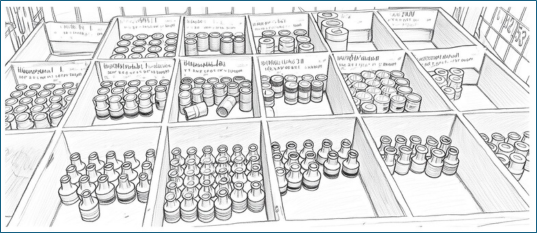
For example, one improvement project aimed at parts identification and retrieval time reduction. The Logistics Kaizen approach enabled team to examine the area and develop a store label format that can solve the problem at bin level. This reduced part identification and retrieval time by 40% resulting in direct positive impact on productivity and inventory accuracy metrics. The team was able to develop the solution by observing good practices in unrelated industry as part of CII Logistics Kaizen Activation program.
Applications Across Sectors
Kaizen-driven improvements have broad relevance across India’s economy:
- Manufacturing: Streamlining in-plant logistics (e.g. kanban material flows, optimized layouts) to reduce work-in-process inventory and avoid production delays.
- Retail / FMCG: Lean warehousing and distribution (efficient store restocking, better shelf layout) to minimize stockouts and markdowns.
- Pharmaceuticals: Enhanced cold-chain and inventory practices (strict temperature monitoring, FIFO rotation) to ensure on-time delivery of medicines with minimal spoilage.
- Agriculture & Food Processing: Faster crop-to-market handling (improved sorting, grading and cold storage) to reduce perishability and waste.
- Ports & Multimodal Logistics: Kaizen projects at terminals can shorten loading/unloading times and improve coordination between road, rail and waterways, reducing congestion on key corridors.
These applications align with national priorities. For example, the government’s Sectoral Policy for Efficient Logistics (SPEL) is targeting efficiency in industries like pharmaceuticals, food processing and minerals. Kaizen provides a practical, bottom-up method to achieve those sector-specific efficiency gains.
Driving Efficiency, Cost Savings and Agility
In practice, Kaizen projects yield clear efficiency and cost benefits. By eliminating non-value-added steps, for instance, reconfiguring a warehouse aisle or streamlining documentation flow, companies can measurably cut cycle times and expenses. Even small process changes can reduce transport or inventory carrying costs, which is significant given logistics consumes roughly 8–9% of GDP in India. DPIIT’s logistics study notes that addressing bottlenecks (e.g. congested routes, modal imbalances) is key to reducing expenses, and Kaizen complements this by streamlining operations at the ground level.
Importantly, Kaizen also builds supply-chain agility. When frontline teams are empowered to detect and solve problems quickly, companies can adapt faster to demand changes or disruptions. This agility supports India’s broader competitiveness goals: for instance, the National Logistics Policy aims to move India into the top 25 of the World Bank’s Logistics Performance Index. Every improvement in speed, reliability or cost moves us toward that target.
Conclusion: Aligning with National Logistics Goals
The CII Logistics Kaizen Activation Drive exemplifies industry-led progress toward national logistics objectives. By institutionalizing continuous improvement across manufacturing, retail, pharma, agriculture and transport sectors, the initiative helps achieve the NLP’s cost-reduction and efficiency targets. Industry platforms like CII bridge policy and practice: they convene companies, share best practices and maintain focus on goals such as shorter lead times, waste reduction and cost savings. In partnership with government reforms (like PM GatiShakti’s integrated planning), the Kaizen drive strengthens India’s logistics networks and overall competitiveness. Ultimately, these collaborative efforts move the country closer to its vision of world-class logistics performance and sustained economic growth.

Sport as a Tool for Community Development and Industry Engagement
Sports is no longer viewed as a leisure activity, but...
Read More
Match AI models to workloads, not leaderboards
The Artificial Intelligence (AI) industry has remained fixated on model...
Read More
Productivity: The engine of manufacturing growth
For the past decade, India’s manufacturing story has been about...
Read More
Skilling India’s Gig Workers: Policy Gaps and Industry’s Role
India’s rapidly expanding gig and platform economy has emerged as...
Read More
MedTech for All: Driving Accessible, Affordable & Quality Healthcare
India’s MedTech industry is expanding its role in both domestic...
Read More