
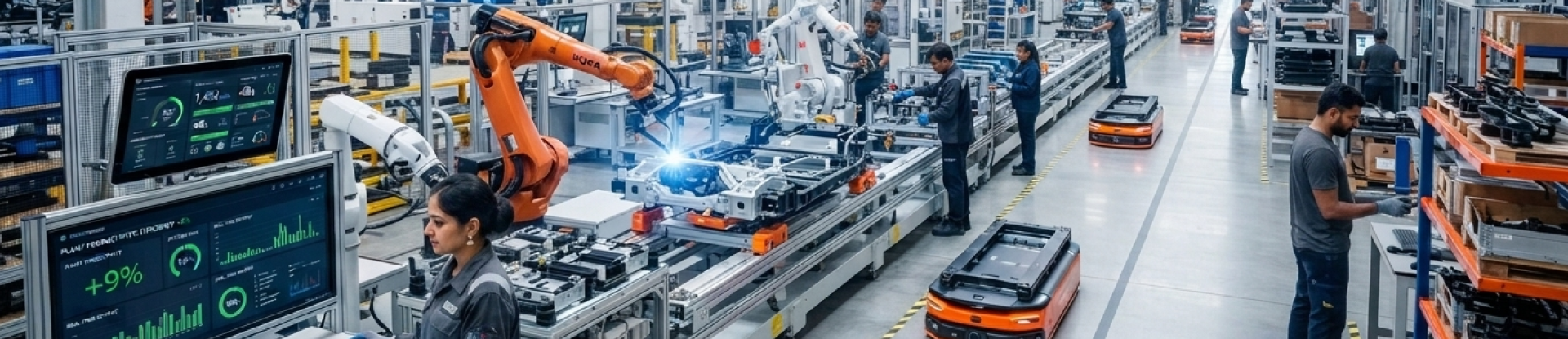
For the past decade, India’s manufacturing story has been about scale—bigger factories, higher investments, and expanded output. This capacity creation has been real and consequential. Yet the next phase of industrial expansion cannot rely on size alone. It must be powered by productivity—the value we draw from every unit of capital, labour, energy, materials and services. Only then can our manufacturing ambitions truly support the Viksit Bharat mission by 2047.
Trends in total factor productivity (TFP) tell a cautionary tale. In simple terms, TFP captures how much output an economy squeezes from its capital, labour, energy, materials and services—growth from working smarter, not just from adding more of everything. ASI-based estimates show that TFP in manufacturing grew at 2.3% in the 1980s, slipped into negative territory in the 1990s, recovered to 2.1% in the 2000s, and has moderated slightly since 2012. The cycle is clear: productivity gains rise and fall, but they have never been placed on a sustained upward path.
Productivity cannot be left to chance— it must be deliberately cultivated through policy, industry action, and institutional support. Seven priorities stand out as critical levers to embed productivity as the cornerstone of manufacturing growth.
Closing innovation gap
India spends just 0.64% of GDP on R&D, far below China, the US or South Korea. Private industry contributes barely a third of this, compared to three-quarters in leading economies. The Anusandhan National Research Foundation and the Rs 1 lakh crore R&D initiative provide a strong framework, but industry must step up. A practical target could be 1.5% of GDP by 2030, with private firms contributing half.
Integrating with global value chains
A 1% rise in GVC participation lifts per-capita income by more than 1%. India’s backward linkages have strengthened since 2019, aided by Production Linked Incentive schemes that have attracted Rs 2 lakh crore in investment, generated Rs 19 lakh crore in output, and created 13 lakh jobs. GVC integration must become a central pillar of industrial strategy if manufacturing is to reach 25% of GDP by 2035 and create 140 million jobs. The lesson from East Asia is clear: countries that embedded themselves in global production networks saw rapid industrial upgrading.
Fixing the missing middle
Micro-enterprises dominate Udyam registrations, while medium-sized firms—the engines of productivity, exports and formal employment—remain sparse. Credit constraints, regulatory thresholds and limited market access hold them back. Policies must enable small firms to scale into globally competitive medium-sized enterprises.
Investing in human capital
Productivity depends on skills. Expanding access to high-quality vocational and technical education is essential. Industry should lead in creating apprenticeships aligned with the National Skills Qualification Framework.
Aligning physical and digital infrastructure
Infrastructure has improved with the PM Gati Shakti plan and central capital expenditure. Logistics costs now have a scientific baseline at 7.97% of GDP. On the digital side, UPI transactions reached Rs 261 lakh crore in FY25, while GST registrations crossed 15.1 million. Sustaining this requires addressing cross-subsidisation of industrial power tariffs and leveraging the National Critical Mineral Mission to secure inputs.
Keeping reform momentum
The GST rationalisation of 2025 simplified rates and corrected inverted duty structures. The Jan Vishwas Acts decriminalised procedural provisions, promoting trust-based compliance. Alongside the Single Window System, IBC and labour codes, these reforms reduce friction. Deepening them will ensure productivity gains are fully realised.
Benchmarking performance
Most MSMEs lack reliable mechanisms to compare themselves with sectoral or global peers. A national productivity benchmarking platform could change this, allowing firms to measure labour and energy productivity, machine utilisation and quality standards against global frontiers.
To conclude, India’s ambitious economic targets cannot be achieved by inputs alone. Capital and labour expand the baseline of production, but productivity compounds growth. The government has laid strong foundations. However, it needs to continue work on issues such as power, land and other factors of production. Industry must match that vision with efficiency and continuous productivity improvement. Together, they can make Indian manufacturing larger, more competitive, and a defining partner in India’s journey to becoming a developed nation by 2047.
Note: This article was first published in Financial Express
Latest Post
Considerable benefits using 1win for mobile gaming and casino experiences
Considerable benefits using 1win for mobile gaming and casino experiences...
Read MorePolitical events forecasting with kalshi offers unique insights into future outcomes
Political events forecasting with kalshi offers unique insights into future...
Read More