India’s demographic dividend gives it an advantage over other countries when it comes to growing the labour force and economic prosperity. But as the country undergoes this demographic transition, it becomes imperative to strengthen health and ancillary services centering on the needs of an ageing population. The elderly population (60 years and above) is projected to double from 100 million in 2011 to 230 million by 2036. This indicates that by 2036, nearly one in every seven Indians will be aged 60 years or older.
Ageing is a natural phenomenon of the life cycle, bringing both, new possibilities and challenges. In today’s day, increase in longevity and decline of joint family and a gradual breakdown in our social fabric has pushed seniors into loneliness and neglect. As a result, ensuring their physical and mental well-being is no longer a welfare concern alone, but a critical determinant of quality of life in the advancing years.
Government Initiatives for the Elderly
Recognising the scale and urgency of population aging, India has implemented a multi-layered legal and policy framework to support senior citizens.. Key policies include the National Policy on Older Persons, 1999; the Maintenance and Welfare of Parents and Senior Citizens Act, 2007; and the National Policy for Senior Citizens, 2011. The National Programme for Health Care of the Elderly (NPHCE), delivered through Health and Wellness Centres under the Ayushman Bharat, plays a crucial role in providing dedicated healthcare to elderly at the primary healthcare level. This focus on early intervention and continuity of care is essential in managing chronic and age-related conditions.
At the global level, India, has reaffirmed its commitment to promoting healthy ageing through primary health care at the recent World Health Organization (WHO) meeting, to emphasize on people-centric systems for the elderly.
The NPHCE is currently operational in around 92 per cent of districts, forming a cornerstone in India’s effort to develop a preventive, promotive, curative and rehabilitative service for the senior citizens through a primary health care approach. Parallelly, the Ayushman Bharat’s Pradhan Mantri Jan Arogya Yojana (AB–PMJAY) has been expanded to cover all citizens aged 70 years and above, thus strengthening financial protection against health shocks.
The Union Government has also established two National Centres of ageing, one at All India Institute of Medical Sciences (AIIMS), New Delhi, and another at Madras Medical College, Chennai, and 17 regional geriatric centres, serving as hubs for clinical excellence, capacity building, research and policy guidance.
In addition to healthcare, social security and assistive care support remain equally important. The Atal Pension Yojana aims to provide income security post-retirement, while the Rashtriya Vayoshri Yojana provides assisted living devices, including but not limiting to walking sticks, elbow crutches, walkers, hearing aids, etc. for senior citizens suffering from age-related disabilities, helping in restoring near-normal bodily functions, like mobility, independence and dignity.
Role of Technology
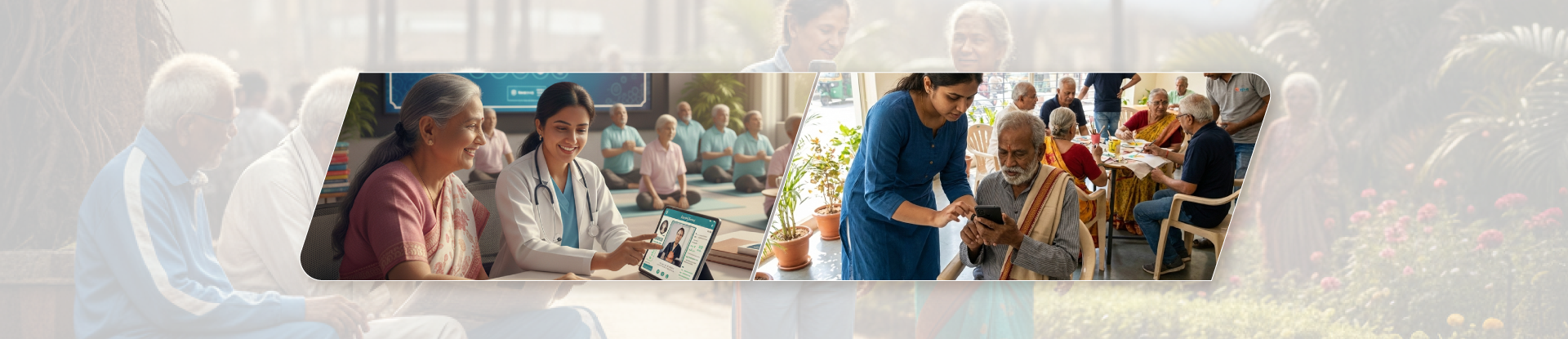
Technology also plays an important role in strengthening access, safety and independence for India’s elderly population. Digital interventions are bridging the gaps in healthcare delivery and daily support, particularly through telemedicine platforms such as e-Sanjeevani; wearable devices such as smart watches and fitness bands; smart home technologies such as cameras and sensors; and online pharmacies. Together, these innovations support a safer, more dignified aging experience and can significantly improve quality of life when designed for inclusivity.
Way Forward
India has time and again demonstrated through its policies that it is committed to the UN Decade of Healthy Ageing (2021-2030), viewing ageing not merely as a challenge but as an opportunity for inclusive growth and social transformation. However, translating intent into outcomes requires a comprehensive and coordinated model of care. Strengthening senior care is essential not only to fulfil India’s quest for development, but also to build a robust and resilient public health ecosystem.
According to a report in NITI Aayog, four core areas of health, social, economic/financial, and digital should be the main focus for empowerment, service delivery, and inclusion of senior care as a national priority and goal. Addressing these areas together, rather than in silos, will be key.
India’s silver economy was valued at approximately INR 73,000 crores in 2024 and is projected to grow multiple folds in the coming years. Senior citizens along with the age bracket of 45 to 64, constitute the ‘wealthiest age cohort’ globally, making the senior care segment crucial for India’s growth trajectory.
The burgeoning silver economy also opens new avenues for innovation. It creates opportunities for businesses and organizations to address the needs and preferences of the elderly demographic, both domestically and internationally. Public-private collaboration across the healthcare ecosystem, coupled with the active involvement of Panchayati Raj institutions, Urban Local Bodies, and civil society organisations like NGOs, can enable effective, efficient and time-bound implementation of senior care solutions.