
The world is facing an escalating water resource challenge. Today, nearly 2 billion people live in water-stressed regions, while 2.2 billion people still lack access to safely managed drinking water. If current consumption patterns continue, global demand for freshwater is likely to outstrip supply by nearly 40% by 2030.
Climate Change and Water Stress
Increasing climate variability and change are further exacerbating the above this challenge. Water and climate change are inextricably linked. Rising temperatures are altering the water cycle with rainfall becoming more unpredictable, while droughts and floods are becoming more severe and frequent. Climate change is leading to water scarcity and contaminating water supplies.
The latest Intergovernmental Panel on Climate Change assessment warns that continued global warming will intensify the global water cycle, increasing the variability of rainfall and the severity of both floods and droughts.
Impact on Communities and Gender Equality
Climate variability brings distinct changes to the hydrological regime and influences the spatial and temporal patterns of water resources in a region. Climate change affects the basic components of the hydrologic cycle such as precipitation, soil moisture, evaporation, and atmospheric water content. These changes impact lives and livelihoods. The burden of this growing challenge falls disproportionately on women and girls who bear the primary responsibility for water collection and household water management.
Challenges for Industries in Water-Stressed Regions
In this scenario of increasing resource variability and stress, industries are also facing considerable challenges in ensuring operations and sustaining business. Industries operating in water-stressed regions may have an impact not only on the local ecosystems but also community livelihoods and gender equality.
Shift Towards Sustainable Water Management
As a strategy for sustenance aligned with ensuring ecosystem health and stakeholders therein, industries are moving beyond water efficiency goals towards adoption of more resilient water management approaches, including frameworks such as water neutrality and watershed-level management. Responsible water management can reduce stress on local water sources, improve community access, and support broader social development as well reduce gender inequality as far as water is concerned.
Policy Framework and Institutional Support
A comprehensive framework in this regard has been developed by the NITI Aayog which prepared the “Report on Water Neutrality for Indian Industry: Standardization of the definition and approach”. These guidelines offer a clear framework to help industries balance their water consumption through sustainable practices.
CII Water Institute, CII’s Centre of Excellence on Water, played a key role in developing this standard approach and supports industries in achieving water neutrality to safeguard their operations and ensure long-term sustenance as well as make the local ecosystems water resilient
What is Water Neutrality?
Water neutrality means that the total freshwater used by an industry – both directly and indirectly, including its supply chains is balanced by measurable water savings. These savings come from improved operational efficiency, water reuse, and efforts to replenish and rejuvenate water sources within the same watershed or those of major supply chains. The goal is to ensure that industries use water responsibly and contribute to replenishing the water they consume.
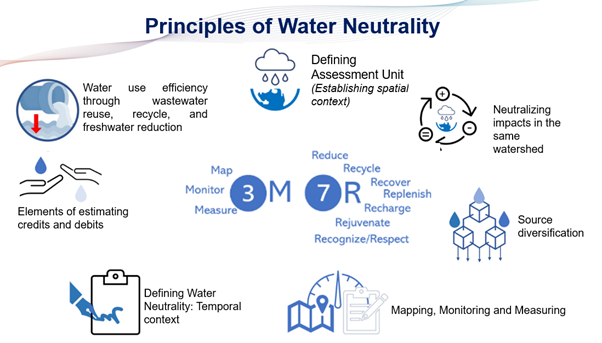
3M–7R Approach to Water Neutrality
To achieve this, industries can follow the 3M-7R approach outlined in the guidelines:
- 3M: Measure, Manage, and Mitigate water use.
- 7R: Reduce, Reuse, Recycle, Recharge, Replenish, Report, and Respect water resources.
Why Water Neutrality Matters for Industries
Water neutrality is not just about protecting the environment. It also offers significant benefits to industries:
- Reduces Risks: Minimizes disruptions caused by water shortages, ensuring continuous operations.
- Ensures Compliance: Helps industries meet regulatory requirements and enhances their Corporate Social Responsibility (CSR) profile.
- Strengthens Supply Chains: Reduces water-related risks across the supply chain, improving overall business resilience.
How Industries Can Achieve Water Neutrality
A Water Neutrality assessment can help industries assess their water use, identify gaps, and adopt sustainable practices. The assessment follows a 3-step approach:
Aspiring Water Neutral/Positive Company (Scope 1):
Focuses on reducing direct water use and implementing immediate offset strategies.
Rising Water Neutral/Positive Company (Scope 2):
Extends efforts to the supply chain by considering virtual water use and offsetting it.
Achieved Water Neutral/Positive Company (Scope 3):
Establishes systems for long-term monitoring, verification, and improvement.
Steps to Begin the Journey
Industries can start by:
- Evaluating Water Use: Identifying direct and indirect water consumption.
- Improving Efficiency: Implementing technologies and processes to reduce water consumption.
- Offsetting Water Use: Engaging in water conservation efforts like rainwater harvesting and recharge, lake rejuvenation, and watershed management.
Conclusion: The Way Forward
Water neutrality is more than just a sustainability goal—it is a strategy for securing industrial growth while ensuring environmental balance. As climate challenges intensify, industries that embrace water neutrality will be better prepared to adapt and thrive.
By adopting NITI Aayog’s guidelines and leveraging the expertise of CII Water Institute, industries can take meaningful steps toward becoming water neutral. This journey not only protects business operations but also contributes to a water-secure future for India, benefiting community at large and women, in particular.
The time to act is now. By taking small but significant steps, industries can protect their operations and contribute to building an inclusive and sustainable tomorrow.
Explore more at: https://www.cii-twi.in/

World Water Day 2026: Building Water Resilient Industries for a Water Secure Future Leading to Gender Equality
The world is facing an escalating water resource challenge. Today,...
Read More
UK-India Tech Skills Exchange: Unlocking Growth Through Talent
In July, India and the United Kingdom signed a landmark...
Read More
India to the World: Changing Ecosystem of India’s Media & Entertainment Sector
India’s stories are winning hearts across the world and our...
Read More
Chinese Engagement: India Has Struck an Optimal New Balance
India’s recalibration of its approach to Chinese investments marks an...
Read More
Child & Adolescent Health Outcomes in India
The health and well-being of India’s children and adolescents are...
Read More