The journey towards a vibrant society must start by nurturing the potential of our youngest citizens. In the past few years, Bharat has placed its youngest citizens at the heart of its developmental strategy, defining its natural priorities around education, digital infrastructure, and access. Critical importance has also been given to the first classroom that a child usually steps into, the Anganwadi.
Anganwadis are a critical pillar of growth in India’s public health and education sector, especially in rural areas. Rooted in the Integrated Child Development Services (ICDS) scheme, they are aimed at improving the nutrition and health status of children under six years, pregnant women, and lactating mothers. They provide six core services: supplementary nutrition, immunization, health check-ups, referral services, preschool education, and health education. These services are implemented through a network of Anganwadi workers and helpers who directly influence the way women and young children access their first classroom.
NEP 2020
In the past decade, the government has fundamentally reimagined its approach to early childhood development. The National Education Policy 2020 marked a watershed moment as it largely recognized the critical developmental role of the years before age six. It made it clear that a smarter, healthier, and more productive population is possible only when the first six years of life are prioritized. International studies have shown that children who participate in quality Early Childhood Care and Education (ECCE) programs before the age of five are 67% more likely to have higher IQs, better social skills, and improved academic performance.
Poshan Bhi Padhai Bhi
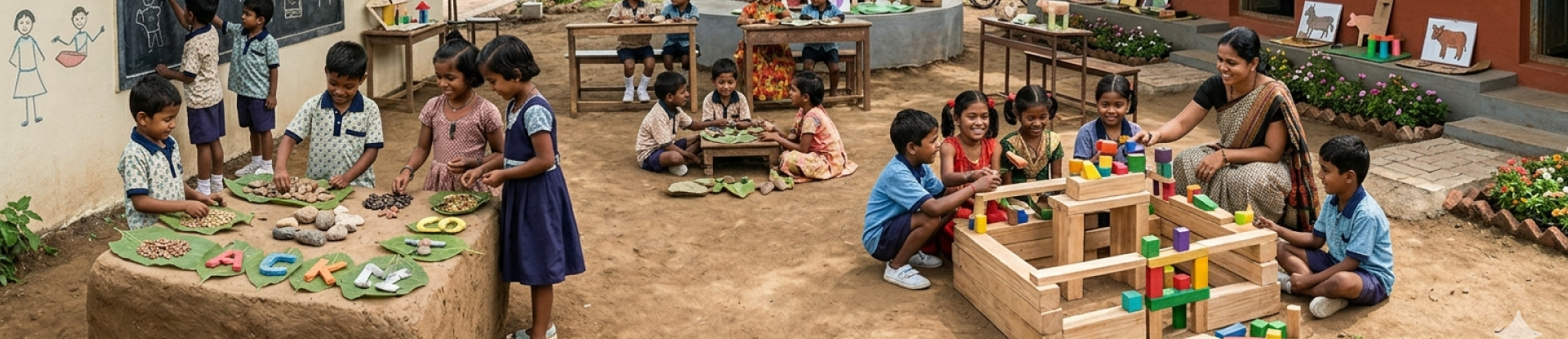
Recognizing the importance of ECCE, the Ministry of Women and Child Development launched Poshan Bhi Padhai Bhi, an initiative that has helped transform Anganwadi centers into vibrant learning hubs. Anganwadi workers are being systematically trained in ECCE with a focus on activity-based and play-oriented approaches using local and indigenous materials. Budget allocations for teaching and learning materials have also been significantly enhanced, and monthly ECCE days have been institutionalized, making Anganwadi centers not just a place for nutrition, but for creativity, play-based growth, and holistic development.
The Ministry has also introduced Aadharshila, a national curriculum for early childhood care and education for children aged 3 to 6 years. Aadharshila focuses on the holistic development of children, emphasizing not only intellectual growth but emotional, physical, and social well-being. It provides a foundation stone for children’s overall development through play-based learning aligned with NEP 2020, using more than 150+ play-based activities to build cognitive, social, and physical development, and strengthen language and numeracy skills. It is structured as a 48-week curriculum, with states given the flexibility to adapt it to local cultural contexts.
Toy-Based Pedagogy for Educational and Social Development
Toy-based pedagogy is in alignment with NEP 2020 and the Prime Minister’s vision for Vocal for Local. Toys not only help in the cognitive development of children and ignite creativity and problem-solving skills, but they are also a powerful form of pedagogy that can be easily used by parents at home. What is significant is that toys are often a portrayal of the cultural heritage of a country, and they strengthen the psychomotor and emotional development of a child’s personality.
Combining India’s rich regional variations in culture, toys that originate from particular regions and communities are important not only for inculcating a broader societal understanding in children, but they also serve the economy. These local ways of making toys, whether the lacquered wooden toys of Channapatna or the naturally-dyed Kondapalli figurines are more sustainable, more reliable, and safer than mass-produced imported toys, which are often unhygienic and unsafe for children.
The Indian toy industry has witnessed a 52% decline in imports and a 239% rise in exports in FY 2022-23 in comparison to FY 2014-15. India’s toy industry is poised to become a key player in the global market as we gear up to double manufacturing units, reduce imported inputs and increase gross sales value in the coming few years.
Conclusion
As the pre-school education sector shifts its focus on play-based learning, we not only enhance the emotional and social growth of a child, but also preserve culture, bring economic empowerment, and a core national strategy that focuses on all aspects of development. Making the child’s earliest years locally-rooted, culturally- grounded, and pedagogically sound is the foundation to make it Bharat.