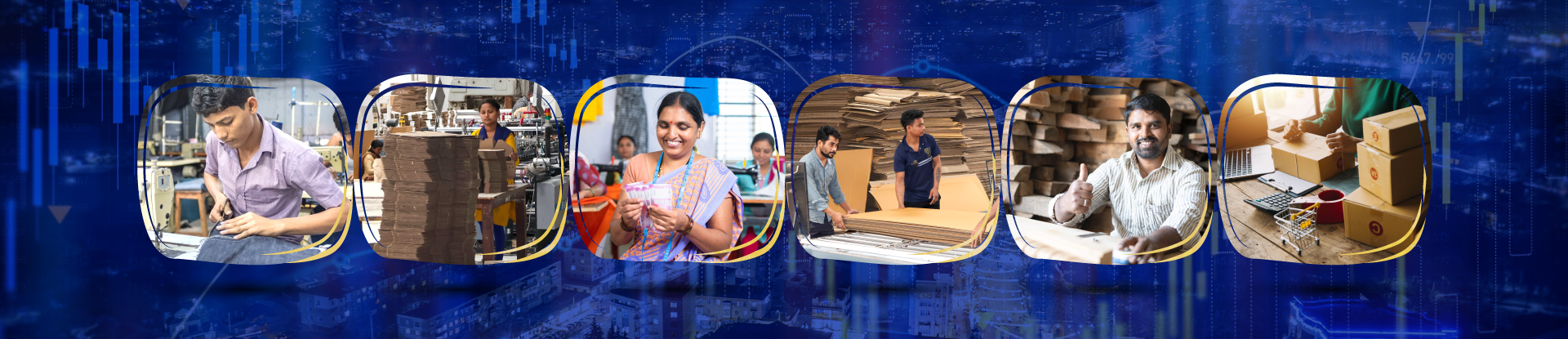
Micro, Small and Medium Enterprises (MSMEs) continue to be one of the strongest pillars of India’s economy, contributing nearly one-third of the country’s GDP, accounting for almost 50 percent of exports, and generating employment for over 380 million people. The expanding footprint of MSMEs is further reflected in the more than 87.5 million enterprises registered on the Udyam Registration Portal and Udyam Assist Platform, highlighting the increasing formalisation and depth of India’s entrepreneurial ecosystem.
MSMEs play a critical role in driving inclusive growth by creating opportunities across urban and rural India, supporting local value chains, fostering entrepreneurship, and strengthening India’s manufacturing base. As India advances towards its vision of becoming a developed economy, MSMEs will remain central to achieving higher economic growth, expanding exports, enhancing manufacturing competitiveness, and generating large-scale employment opportunities.
At a time when global supply chains are undergoing significant realignment and countries are seeking reliable manufacturing and sourcing partners, Indian MSMEs are presented with an unprecedented opportunity to integrate into domestic and international value chains. However, realising this opportunity requires addressing several persistent challenges. Access to affordable and timely finance, working capital constraints, delayed payments, infrastructure bottlenecks, regulatory complexities, technology adoption gaps, skill shortages, sustainability requirements, and increasing global competition continue to impact MSME growth.
In addition, geopolitical developments, supply chain disruptions, evolving trade frameworks, and emerging compliance requirements are creating new pressures on businesses. Strengthening competitiveness, accelerating digital transformation, improving ease of doing business, enhancing productivity, promoting innovation, and supporting sustainability readiness will therefore be essential to increasing the contribution of MSMEs to national growth and enabling them to become stronger participants in global supply chains.
The CII National MSME Council serves as a premier platform for advancing the competitiveness, resilience, and sustainable growth of India’s MSME sector through industry collaboration and policy advocacy. The Council’s priorities for 2026–27 are focused on enabling MSMEs to scale, innovate, and integrate more effectively into domestic and global value chains.
CII National MSME Council Priorities for 2026–27
To support the next phase of MSME growth and competitiveness, the CII National MSME Council will focus on the following priority areas during 2026-27:
- Improving Access to Finance and Faster Credit Flows
- Strengthen credit accessibility for growth-oriented MSMEs.
- Promote innovative financing mechanisms and alternative lending platforms.
- Address delayed payment issues and improve working capital availability.
- Accelerating Technology Adoption and AI Readiness
- Enable MSMEs to adopt Industry 4.0 technologies, Artificial Intelligence, automation, and digital tools.
- Facilitate technology partnerships and capability-building programmes.
- Enhancing Global Competitiveness and Export Growth
- Support MSMEs in integrating with global value chains.
- Improve export readiness through market intelligence, standards compliance, and international partnerships.
- Leverage emerging trade opportunities and Free Trade Agreements.
- Driving Sustainability and ESG Adoption
- Build awareness and implementation capacity around ESG, Responsible Business Conduct, and decarbonisation.
- Support MSMEs in meeting evolving global sustainability and supply chain requirements.
- Strengthening Manufacturing and Supplier Ecosystems
- Expand OEM-Supplier collaboration programmes.
- Improve quality, productivity, operational excellence, and localisation across supply chains.
- Ease of Doing Business and Policy Advocacy
- Advocate for regulatory simplification and reduced compliance burdens.
- Provide evidence-based policy recommendations through research and stakeholder consultations.
- Skill Development and Future Workforce Readiness
- Address sector-specific skill gaps.
- Promote entrepreneurship, managerial capability, and digital skills development.
- Fostering Innovation and Entrepreneurship
- Encourage innovation-led growth through incubation, technology transfer, and startup-MSME collaboration.
- Promote adoption of emerging business models and product innovation.
- Strengthening MSME Resilience
- Support enterprises in managing geopolitical, supply chain, and market-related risks.
- Promote business continuity planning and resilience-building frameworks.
- Data-Driven Policy and Ecosystem Development
- Leverage insights from the CII-ISB Pan-India MSME Study to shape future interventions.
- Strengthen stakeholder collaboration among industry, government, financial institutions, academia, and technology providers.
CII’s Continued Commitment to MSME Growth
Recognising both the immense potential and the evolving challenges faced by the sector, CII has been working extensively to support MSMEs through policy advocacy, stakeholder engagement, knowledge creation, capability building, and market-linkage initiatives.
Over the past year, CII has engaged with the Government on a wide range of issues relating to access to finance, ease of doing business, technology adoption, exports, sustainability, market access, labour, and competitiveness. A major initiative in this direction is the ongoing Pan-India MSME Study being undertaken jointly with the Indian School of Business (ISB), aimed at generating evidence-based recommendations to strengthen the MSME ecosystem and support future policy interventions.
As part of this effort, CII organised an AI-enabled Focus Group Discussion, bringing together MSME leaders from across the country to capture insights on critical growth challenges and emerging opportunities. CII has also convened platforms such as the MSME Leadership Summit, consultations on the proposed SME Growth Fund, discussions on Responsible Business Conduct and ESG, and programmes on finance access and vendor development, bringing together policymakers, financial institutions, industry leaders, and enterprises to deliberate on practical solutions for growth and competitiveness.
During the disruptions arising from the West Asia crisis, CII actively engaged with the Government to share industry concerns relating to logistics disruptions, rising freight costs, working capital stress, raw material shortages, gas supply constraints, export delays, and supply chain challenges. Based on extensive industry consultations, recommendations were submitted to facilitate timely interventions and support business continuity for affected enterprises.
CII has also been working to strengthen global market opportunities for MSMEs through international engagements and business cooperation initiatives, including discussions with the Portuguese Chamber of Commerce and Industry to promote partnerships, technology collaboration, and market access.
Efforts are underway to strengthen supplier ecosystems through the OEM Supplier Excellence Programme, which seeks to help MSMEs enhance capabilities, improve operational and sustainability performance, adopt new technologies, and integrate more effectively into domestic and global manufacturing value chains.
As India celebrates International MSME Day, the focus must now shift from enabling survival to enabling scale, competitiveness, innovation, and global integration. With collaborative efforts between government, industry, financial institutions, and ecosystem partners, Indian MSMEs can play an even greater role in driving economic growth, employment generation, export expansion, and the nation’s journey towards becoming a globally competitive developed economy.