
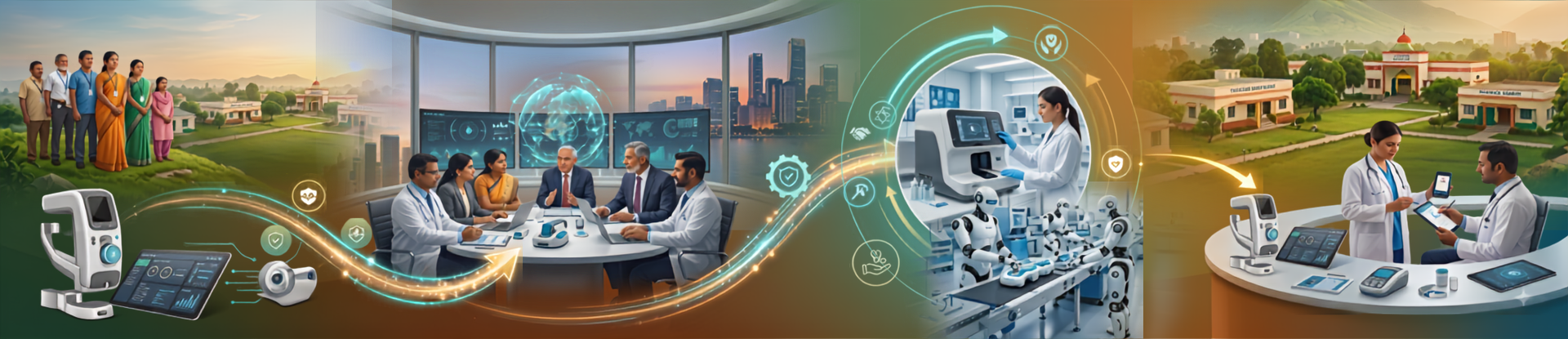
India’s MedTech industry is expanding its role in both domestic healthcare and global markets. It is valued at approximately USD 16 Bn, close to 2% of the global market, worth around USD 680 Bn. The opportunity in the Indian MedTech sector to serve growing domestic and international demand, leverage inherent cost advantages, and build on an emerging manufacturing ecosystem is huge. The government has positioned the sector as one of the pillars of Make in India, in line with the Viksit Bharat 2047 roadmap.
India is amongst the fastest-growing MedTech markets in the world, with a strong manufacturing base, a maturing innovation ecosystem, and a policy push towards self-reliance. Together, these are moving the country towards becoming a global hub for affordable, high-quality medical devices. Government initiatives like Biopharma Shakti, Anusandhan National Research Foundation (ANRF), MAHA MedTech Mission, and the Promotion of Research and Innovation in Pharma MedTech (PRIP) scheme, are designed to strengthen research and innovation, and to carry India from low-cost manufacturing towards high-value MedTech innovation.
The gap between what the sector can produce and who actually receives it remains wide. Access to healthcare technologies is uneven across geographies, both within India and across low- and middle-income countries that India increasingly supplies. Closing that gap requires governments, industry, academia and multilateral institutions to work together, so that innovation is affordable and also meets high standards of safety, efficacy and quality, and so that it reaches patients as measurable health outcomes.
Against this backdrop, the 18th CII Global MedTech Summit will be held in New Delhi on 21 August 2026 under the theme “MedTech for All: Driving Accessible, Affordable & Quality Healthcare”. The summit will address what it takes to deliver medical technologies across Tier 1 and Tier 2 cities and into rural districts at a consistent standard of quality, on the argument that access without quality builds no trust and improves no outcomes.
The summit will bring together policymakers and drug regulators alongside industry leaders from MedTech companies, researchers and academicians, and healthcare IT professionals and data scientists. Also in the room will be international associations, startups and incubators, healthcare providers and hospitals, and consultants, planners, and marketing and PR professionals working across the sector.
Objectives
The focus of the summit is on innovation that is both inclusive and quality-driven, putting forward technologies that are affordable, scalable and suited to healthcare settings of widely differing capacity, while holding to high standards of safety, efficacy and quality. Supporting this is a wider effort to build working partnerships across industry, policymakers, academia and international organizations, and to open policy conversations on regulatory harmonization, ease of doing business and quicker routes to adoption for new products. Domestic manufacturing runs through all of it, with India’s capability as a MedTech production and export base for global markets a central point of attention, alongside efforts to draw investment and build research collaborations in emerging areas of the sector.
Key Discussion Areas
Engineering that is affordable, frugal, and quality-centric sits at the base of this, using cost-effective design and indigenous innovation to widen access without loosening compliance with global standards of quality, safety, and performance. Recent global disruptions have exposed the weaknesses in the sourcing of components, raw materials, and logistics, so attention turns to building MedTech ecosystems that are self-reliant and resilient, with local manufacturing at their core. Alongside this comes the work of strengthening healthcare infrastructure and last-mile access, better diagnostics, deeper integration of digital health, and medical technologies reaching rural and remote regions, all held to consistent standards of care and patient safety. Regulatory harmonization carries the rest of the load, with converging frameworks, adoption of global quality standards and streamlined approval pathways making it easier to do business and faster to deploy innovation safely and effectively.
The 18th CII Global MedTech Summit aims to be a working session, rather than just a platform for stage talks and deliberations. Over the course of the day, the conversations will move from what India can build to what it can deliver, and to whether a patient in a district hospital sees the benefit at the same time as one in a metro. Bridging that gap is the real measure of progress in this sector. Bringing regulators, manufacturers, clinicians, researchers, and investors into the same room is the first step towards closing it, and the summit is designed to send participants back with commitments they can act on rather than conclusions they can only agree with.
For more information visit: https://events.mycii.in/e000072921/home
Latest Post
Considerable benefits using 1win for mobile gaming and casino experiences
Considerable benefits using 1win for mobile gaming and casino experiences...
Read MorePolitical events forecasting with kalshi offers unique insights into future outcomes
Political events forecasting with kalshi offers unique insights into future...
Read More